Monday, February 26, 2024

Research Of Detectives

 Detective Profession


When starting to create a story, knowing the the physical and overall context of the story allows the story to be depicted realistically, or achieving realism. Although not for every film, because some rather partake in formalism, for my film opening I want to aim towards realism and how that can not only build accurate context, but work with the characters in establishing a certain tone.

To get anywhere near this, I need to first understand...

WHAT THE HECK IS A DETECTIVE?

A detective/criminal investigator is:

- a person that conducts interviews and interrogates, examines records, and raids and arrests criminals
- one who usually specializes in investigating homicides, assaults, felonies (more serious offense)
- job consists of collecting evidence to follow criminal case assigned


Detective vs Police Officer (Patrol officer): Both under LAW ENFORCEMENT

- Detectives have a higher rank than police officers,

 and require more training, examine crime scenes 

(more closely), work with forensic scientists,

interview and interrogate (criminals, victims, witnesses)

, spy on people, follow up on police reports, prepare cases to testify in court.

-Police patrol assigned areas in their community, 

regulate traffic, give search/arrest warrants, 

collect evidence from crime scene, testify in court. 


Analyze:

Now that I know what the difference is, this will help me be more clear about the precise choices I am making in elements like mise-en-scene and costume design. Things like folders with evidence, a board with string or Expo connecting information from the existing case (which is stated as accurate in the upcoming video below), and wearing less casual attire (because they have a higher stance than police) will all be added to create realism. 


I found this video of a real-life private investigator analyzing choices of "detective scenarios" in movies and TV shows, he analyzed one of the shows I am using as inspiration for my film opening, True Detective. In the video, he mentions some of the mise-en-scene elements that made the scene realistic. Videos link:


In this video, the man explains that detectives have the free will to go into whatever house they want, they aren't governed by law enforcement and they are more left alone than police. Furthermore, there was a clip of Woody Harrelson's character in True Detective going to a woman's house and giving her money to get to talk to a witness, which the real-life private investigator deemed as an 8/10 realistic scene. This helps me visualize and further reinforce the character characteristics I have in mind, which I will extend further in my upcoming blogs.

Moving forward:

Now moving forward, I will use this background to start developing my storyboard/script. By the end of this week, I should have at least one of these two options complete, as well as more than half of the other!


law enforcement ,

Sunday, February 25, 2024

Intro to Color

 Color

Using color in film is something that I have been looking into because of my film approach, which involves establishing the tone. I think that color can be used to accomplish a certain aesthetic, but in more intricate pieces, it is used as a contributing factor to tone. Upon doing research (This website helped break down all aspects of color) I found that color is composed of three main parts: hue, saturation and brightness. 


Hue:

- actual color itself

-separated into primary (red, blue, yellow) & secondary (green, orange, purple) made by mixing primary & on the wheel tertiary colors (mixing primary and secondary, red-orange)


Saturation:
- intensity of color (amount of grey mixed into color)


Brightness/ Value: 
- darkness/lightness of color


I hope you enjoy these extravagant colors as much as I enjoyed picking them 😉 One must pick a color palette to include in their film that offers balance, some include the analogous color palette or the complementary color palette which is opposite colors on the wheel which represent conflict. In addition, there are also certain colors that stand alone to showcase something important, for example the discordant color that is the using of a color against a white or neutral background that allows an object to jump out, catch attention.


Analyze/ Review:
After learning about all these aspects of color, I went on Youtube to see the importance of color in some films that are visually inspiring my film opening, like Joker. I watched a video where the DP of Joker explained the use of color on the film. I noticed the redundancy of the orange and blue tones, which related back to the complementary color palette I learned about. In the video, it also said to shoot at dusk to get this lighting and color more precisely, which I will keep in mind for shooting the NYC montage (I am going to NYC during spring break!) I think using contrasting colors is a cool idea that I want to try to play around with, but to do this I need to know how to color grade after color correcting. So, for my future research, I will go into video tutorials on how to color grade on Adobe Premiere Pro, as well as try to use random footage to play around.


More Joker cinematography:

Saturday, February 24, 2024

Film Approach

 Film Approach

 To approach my film I was thinking of just walking straight up to it. 

Got you there!... That was really bad.  Now that the horrible joke summoned you we will be talking about....


How To Approach Your Film!

Technically its not yours its mine, but either way here it is. I have been thinking of film approaches and with the notes we took about a month ago:


I think I know which to choose. I am already going to have to choose to establish setting just because my introduction to the film opening is NYC, but for the rest of the opening, I really want to establish tone. I think creating a specific tone is something that comes satisfying to me, like when someone is erasing Expo of a white board and they finally wipe away the last mark, and I mean REALLY get it. Not just weakly pat it away, I mean fully discard of any trace left. 

I really hope you know what I am talking about or that just makes me really weird.

Establishing tone to me isn't just hoping the audience feels a certain way, which is the final desired goal, but it is using different factors like lighting, color, mise-en-scene, composition, editing, shots, ETC to create a story that you hope makes others feel a certain way. So for me, getting most of those attributes right is key, which I hope to do!

Extra Research:

To accurately depict tone, I needed to find the accurate difference between mood and tone in film, which this sentences from this website describes:

"For instance, you could show your characters attending a party and have the tone be excited, depressed, sarcastic, frightened, or hopeful. These communicate the way the narrator feels about the situation. Mood is the overall feeling of the scene or story as a whole.'"

Review: 
From here, I will look at other aspects that can contribute to my story's tone, and start to develop my story overall. Creating things like storyboards and scripts will all be done by next week!

Thursday, February 22, 2024

Genre Conventions and Film Openings


Genre Conventions

    Week 2 and we are back. After finalizing my genre I have now been focusing on what genre conventions to incorporate into my film opening. But to figure out which ones I want to include, I need to figure out what genre conventions even are, and what they are used for:

Research:

Genre conventions are the specific topics, characters, situations, and plots that are consistent throughout pieces of the same genre. Genre conventions are what assist audiences in identifying specific genres and allow them to choose certain films based on those they want to see. In addition, different approaches on how to develop tone and the type of tone used to create a specific mood is another aspect of genre convention. For example, a horror film will almost always have the use of suspense and violence in its plot. 

Incorporated:

After learning this I went to research genre conventions in my specific genre, murder mystery. Some that I found and have been incorporating into my developing story that have to do with my plot are a crime taking place, a murder on the loose/ murder that has happened, and an investigation. Genre conventions relating to creating specific tones are creating suspense with tension in dialogue and an eerie ambiance with creepy music. There can also be genre conventions within specific characters like the passionate detective and the detective that might be a mole.... KEEP UP WITH MY BLOGS TO FIND OUT!!! 😉😉


         Film Openings  

    With the idea of certain genre conventions in mind, I have also been looking at different films and scenes from murder mysteries or thrillers for inspiration. The first example I have been looking at is the series's first season, True Detective. This is one of my favorite seasons I've ever watched from any show, not just because the acting is phenomenal but because Matthew McConaughey and Woody Harrelson. Thats it. I'm going to go as far as saying that those two names even ignite something in YOU Cambridge individuals, proving that Cambridge, is no different than the rest of us 😏😏. Moving on, I really like the series's character dynamics and how they establish their context with mise-en-scene. Aspects like the relationship between the two main characters, Rust and Marty, is something I want to play with and slightly infuse into my own character dynamics. Even though there is always a stereotypical "good cop" and "bad cop" in many detective or investigation movies, I want to branch out into eccentric character types and also play into the conventions, like including a good cop, but with more depth and nuance to his character. In addition, the two main detectives costume design and surrounding set design is another that I want to take inspiration from. Aspects like the detective's badge around his belt and a simple but put together tie with blazer is a simple but effective base to start for the detectives. I would like to build each detective's wardrobe and add something special according to their personality, for example if one of the detectives is very laid back and doesn't care as much as the others, he might come with messier hair and a collared shirt with no tie or blazer.

Picture of Rust Cohle and his costume design:

Pin by m bong on true detective | True detective art, True detective, Detective. (n.d.). Pinterest. Retrieved February 23, 2024, from https://www.pinterest.com/pin/318770479887995842/

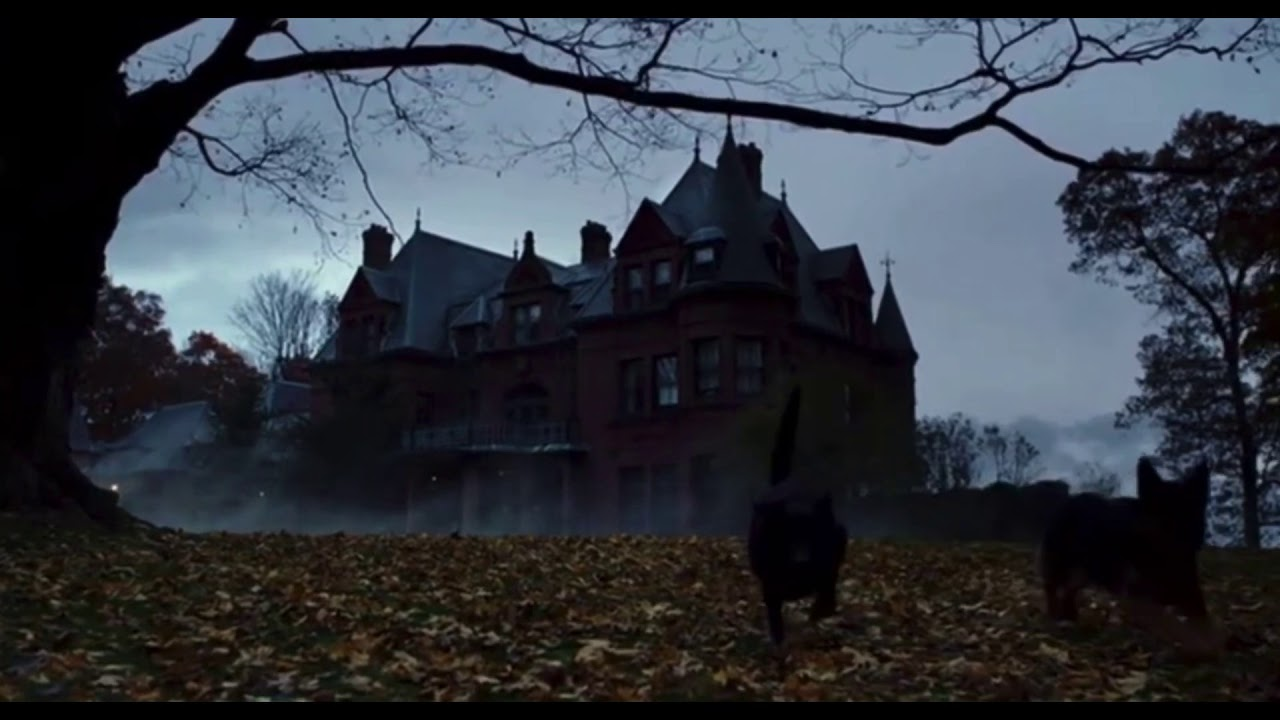
The other inspirations I have are from the movies Knives Out and Joker. Both of these films have aspects of developing tone and establishing setting that I might be interested in using. For example, for my film opening creating an eerie and chaotic tone is one I want to accomplish. Using dark lighting and shadowing is something I am taking inspiration from with the opening scene of Knives Out. I want to create a 20 second New York montage to establish setting, so using these aspects to distinguish my film opening from the start is something I am aiming for. 

knives out intro scene - Google Search. (n.d.). Www.google.com. Retrieved February 23, 2024, from https://www.google.com/search?sca_esv=4a15a4908bf04efe&sxsrf=ACQVn0_PnyWkGOQwwe6Q8pBOSQpWdPRq6Q:1708666336523&q=knives+out+intro+scene&tbm=i
hh


From the movie Joker I am aiming to learn more about the way the movie's cinematographer, Larence Sher, composes his shots and uses color to accompany his story. Further throughout this week I also plan to learn more about color grading because I want to play with color in my film opening. Shots like this one below are some that I use for inspiration when envisioning how I want to my film opening to resemble:
 

In addition, some other influences I've been looking at are at The Bear and True Detective for the actual detective scene I want to include. I am thinking about having a detective scene about trying to find a murderer that has been roaming around the streets and I think season one of True Detective has good mise-en-scene elements and screenwriting that create incredible realism with how detectives act and speak to one another. In addition, for the actual pacing of the scene, I think that The Bear is so good at building up a scene's tension until it breaks out into a shitstorm and I want to incorporate timing to create a really anxious mood for the audience. Also, the way the camera usually stays on a close-up of the character's face and moves around the characters organically is something that I will incorporate in some moments. ONE MORE THING (The Bear has endless things to comment on), I noticed this in The Bear and Joker which was multiple focus pulls that help show how the character is feeling or show a shallow focus on something that is important.

Lastly, I really want to take inspiration from the ICONIC 360 camera spin in That 70's Show that goes all around the group while they are.. having fun and eating brownies!... I think it would be a cool shot to try but in my unique situation.

So, from here on I will keep researching on film approaches, but mostly on color grading techniques and how to seamlessly work with color to build a story.


Sunday, February 18, 2024

Project Genre

 Choosing Genre PT 2.

Hello! Welcome back to....

Choosing my genre!

I am your host Sofia Di Lauro and today we will continue to explore what genre we will select for the show! Okay but actually, LET'S GET TO BUSINESS!


After watching the YouTube video centered on explaining genre that I mentioned in my last blog, some ideas came up on what my plot could look like for the film opening. So, I continued to do research on movies that caught my eye, like the movie "Knives Out."


What I learned was that "Knives Out" is in the genre of thriller, but this classification is a very broad one. So, the movie can also be defined as being in the mystery and crime genre, or even the murder mystery subgenre. The broader genres, like thriller and mystery, still uphold genre conventions, but they are harder to grasp and to meticulously identify. So, subgenres are great for truly narrowing down specific plots and characters, which is what I was having trouble envisioning. 

Learning about all these new genres and how they can intertwine with individualized subgenres, I realized that it doesn't have to be structured in one specific way. I can choose to make a film opening in the thriller genre, but it can also show aspects of other genres under it like mystery and murder mystery. For example, a series I love is "True Detective", specifically the season I watched which is the first season. Season one centralizes on two main police detectives and how they show the criminals they have tracked down and where their lives have led them to. Their main genre of thriller and mystery has other subgenres like crime film and neo-noir that leads them to have this unique show.

So from here on out, my film opening will be in the thriller genre, but have other aspects within the murder mystery subgenre. I will continue to research genre conventions in these genres.


Project Genre

 Choosing Genre PT 1.


I got it. I got my project's genre. I didn't think I would get here without excessive overthinking, but sometimes life just chooses to surprise you!

When brainstorming what genre to select, I first had to fully understand:

What is genre?
Why does genre matter?

SOOOO, what is genre?
Genre is a categorization of specified artistic pieces, in this case, movies, that are all characterized by similarities in style, form, and content. The word "genre" is the universal term used for various art forms, like music or visual art, and is an idea that can be broken down into multiple parts. Some may break up a movie for example into its characters, story, plot, and setting. All movies under a certain genre uphold specific genre conventions or similarities within that genre, that differentiate movies from one another.


Okay that's cool! But why does it matter... 

Genres, specifically in film, have a major significance when dealing with audiences and storytelling. For starters, representing a movie with a specific genre helps audiences create an expectation of what they will be watching, due to traveling genre conventions. Audiences will have an expectation of what they will see and how they will feel when watching a specific genre, for example, when someone watches a horror movie, they walk into the theater with an anticipation of getting scared. If this expectation isn't fulfilled, then the audience will walk out of the theater unsatisfied, negatively affecting the movie's reviews and profits. In addition, genres play a massive role for storytellers. When a filmmaker is creating a story, sticking to a specific genre can help narrow down decisions on certain aspects of the movie. Once the storyteller follows a genre's "recipe", the act of fulfilling an anticipating audience is much easier.

After learning about all this information, I knew that with whichever genre I chose, I would need to focus on delivering its specific conventions, but also in a way that wasn't redundantly done before. Finally, I dove into specific genre types. While doing this, I came across this YouTube video titled "Movie Genres Explained - Types of Films & the Art of Subverting Film Genres" (link here)


While discussing the crime genre, this video showed a short clip of the movie "Knives Out". Seeing this movie reminded me how much I loved it and that I could make a film in that genre. The continuation of the video explored several other genres and subgenres, including the murder mystery subgenre, the horror genre, and the action comedy subgenre.

After watching this video I had a thought pop up. I realized from remembering "Knives Out" that I would really like to do a film opening consisting of an interrogation about an "on-the-loose" murder. Having this idea, I used the previously learned information about genre to realize that I could search for a genre that centers its plot around murder and scenes of interrogation.

As of now, I have just begun the research of genres correlating to this initiating idea. From here, I will choose some of my favorite films that have these scenes and plots and then research their genres. I hope to find repetitions of the same genres so I can narrow down what genre I will partake in! Thankfully now I at least know what my plot will be mainly about for my film opening and what movies to collect that fit into my vision.


Thursday, February 15, 2024

Project Schedule Summary

 Project Schedule

    When approaching this multilayered project, a schedule is necessary. For me specifically, utilizing a visual schedule is the most effective way of breaking down tasks that need to be completed over a long period of time. The schedule provided below is one that's infused with our teacher's recommended outline, but one that also allows me to be flexible with my personal lifestyle. WE ARE STARTING BABAYYYYYYY

Week 2:     2/12-2/18

-        Choose project genre

-        Research film openings 

-        (how credits are integrated)

-        Develop project schedule

-        Choose film opening approach and research film openings with approach I want

Week 3:    2/19-2/25

-        Research editing techniques to incorporate/ watch adobe vids

-        Research genre conventions and choose which to incorporate in film opening

-        Develop the story outline/ storyboard ( first draft of shot list, storyboard w description)

-        Develop the script (writing research, description of it and how developed)

Week 4:     2/26-3/3

-        Research filming locations

-        Research editing and pacing of shots

-        Develop Filming/editing schedule- discuss if any changes according to this new integrated schedule

-        Develop / research mine-en-scene elements (summary/analysis of costume, props, setting, etc)

Week 5:   3/4- 3/10

-        Start filming/ maybe finish! (document filming process)

-        Keep researching editing techniques and playing with adobe/ research any  other project components

-         Begin editing (documentation of process, research into techniques)

Week 6:  3/11- 3/17  (GONE 13-16)

-        Continue production of film opening HAVE ALL AT HOME SCENES DONE (more updates on production how its going, has it been what I expected)

-        Continue editing (document process)

-        Begin developing responses to CCR questions (research/ summary of response to CCR question)

Week 7:  3/18-3/24 LEAVE 24

-        Research information relating to creative critical reflection (summary of response to CCR question)

-        Finish editing of film opening (documentation of editing process)

-        Get peer feedback of editing so far ( summary of peer feedback, picture of messages)

Week 8:     3/25-3/31      LEFT UNTIL 30

-        Research info relating to CCR questions (research and or summary of CCR questions)

-        Get final filmings in New York  (pictures of filming)

-        Edit final project and get peer comments (summary of peer comments and editing journal commenced)

-        Create Creative Critical reflection projects (atleast two different approaches, document developments)

Week 9:    4/1-4/2

-Create final project reflection

- Post project and CCR to blog (put links)


With things like drama competitions and spring break vacations, I need to plan my next 2 months accordingly, I'm a busy girl what can I say! I am currently approaching the end of week 2 and will eventually start completing the tasks from week three.

Friday, February 9, 2024

Transitioning into the Cambridge Portfolio Project!

                           Transitioning Into Cambridge Portfolio Project!

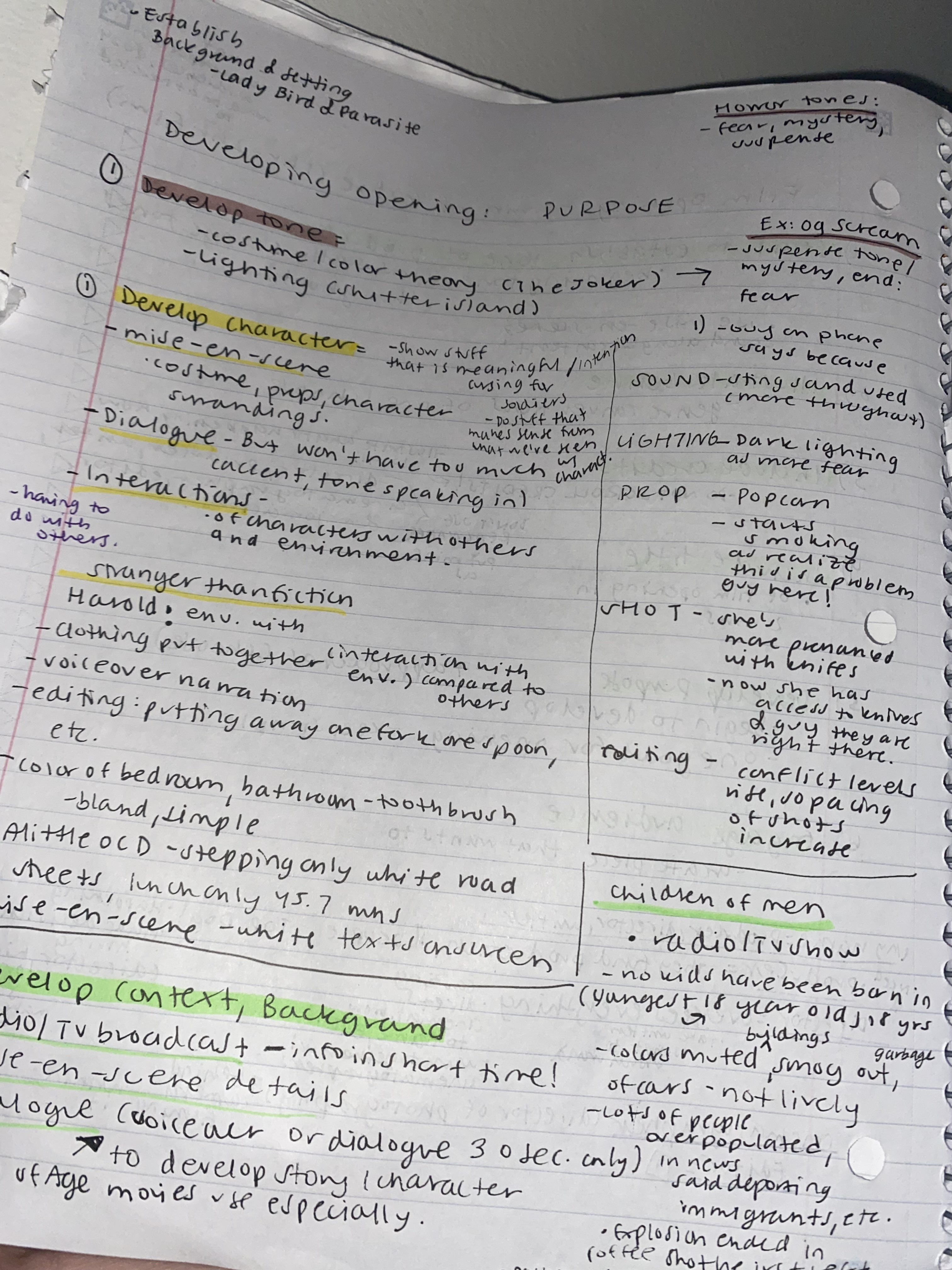
    Hello Cambridge peopleeee! From this moment forward, my posted blogs will be centered on the development of my Cambridge Final Project. All the blogs posted up to this point have helped me navigate significant topics that are contributory to the formation of a well-rounded and admirable film. Being frank, starting this transition is intimidating because this means it's really happening!! But, with the previous and developing knowledge I've researched, I know I can be successful. Having said that, to smoothly jump into this project, my class and I were introduced to film openings and the importance of developing purpose within the opening with a utilized approach:


Out of these approaches, the first one I would be interested in pursuing is developing context and background. I like this approach because for the assignment of doing a two-minute film introduction, establishing context for the continuation of the film is an approach that seems natural and not forced on the story. In addition, providing context to the story is an approach that can fit into many different genres and isn't so centralized or secluded to one. Developing context is also a cool approach that allows one to play with time and it can create an interesting story that isn't visualized so linear. Context is usually incorporated in a film and using it as an opening film approach is a different take on how to integrate it more directly.

The second approach I might consider is developing character. This approach is one that I really like for many reasons. I admire this approach because developing character allows for an immense amount of creativity and innovation to be utilized. Developing character is an approach that heavily relies on aspects like costume design, interactions of the character with its environment, and dialogue to build this character to life. Developing character also gives me the certainty of knowing what I would mainly center my film introduction on, but also knowing that I can expand the content to the character's environment and their relationship to one another.


Friday, February 2, 2024

Music Marketing-2

    This Music Marketing project was one that not only challenged narrow, accustomed ways of thinking, but one that enlightened me on the various routes one could take to accomplish a goal.


   Choosing a song: Starting from the beginning, we were initially tasked with choosing a specific song from a genre my group would be given. My group got handed the pop genre folder, from where we would have to pick a pop song to create a music video for. When going through the list of four songs in the pop genre folder, we were intently focused on picking a song that held lyrics that facilitated creating a visual story, as well as a song that had themes that could be represented through visual concepts. These "prerequisites" were placed because, even though we weren't fully set on what type of music video we wanted to make, we envisioned the video to have a foundation of storytelling. As we listened to all the songs, we finally settled on "Electric Feel" by MGMT. Our finalization came down to the song's aesthetic and direct lyrics, which would aid in developing our story and symbolic notions visually.

   Research: Next, we moved on to researching the modern trends in the marketing and distribution of several pop artists. My group started by attempting to find two of the most well-rounded music production companies from which we would pick two pop artists to research. While searching, we ran into Columbia Records and Atlantic Records. Within each music company, we chose to centralize on Harry Styles and Rosalia for Columbia Records, and Ed Sheeran and Charlie Puth for Atlantic Records. When choosing what pop artists's marketing techniques to analyze, we prioritized artists that rose to fame all by themselves, or those who depended heavily on marketing strategies to get noticed, because they were deemed successful. Regarding Harry Styles, we decided to pick him because even though he was already famous from his years with One Direction, his branding techniques for individualizing his image and aura of music were what drew us to him. For my group, I was chosen to research Harry Styles. During the process of researching his marketing strategies, I found his approaches to advertising to be very insightful relating to his precise approach to his target audience. His creativity with how to approach his audience in eccentric ways allows him to further shine in a crowd full of musicians. For example, when promoting his album Harry's House, Harry Styles created a website where fans could link their Spotify and "collect items for their house". Essentially, fans could get up to 50 new symbols or "items" depending on what songs they listened to from Harry, so if I listen to "Kiwi" by Harry Styles I would get cactus in my "house". This interactive mechanism allowed fans to relate with one another and consistently attempt to guess what each symbol represented, which would spread more "noise" for his new upcoming album.

    After researching techniques from successful artists, we initiated our marketing campaign. When approaching this, my group and I started off focusing on the music video aspect before our campaign presentation. 

Pre-production: This process involved meticulous planning of how we would tie the music video visually and symbolically. Before starting the process, we conversed about what type of music video to create and ended up choosing a promotional/storytelling video. Once we began the process, we instantly created a storyboard so it would be easier to see which production techniques to utilize and how they would all unify in specific shots. To begin, we picked what duration of the full song we wanted to use for the music video and we decided on the second verse to the last chorus. Then, we listened to the song, separating which parts of the song we wanted to be promotional and which we wanted to be storytelling. After having a general idea of the timeline of the music video, we began storyboarding. Going in chronological order, we laid out specific shots we envisioned, and different angles and editing aspects associated with them. A big part of planning the promotional shots was the mise-en-scene elements. Anything from colored lighting to band props to set design was essential to this portion of the video, due to the engaging, specific aesthetic we strived to achieve. Finally, we created our storyboard (first page of the storyboard is below).
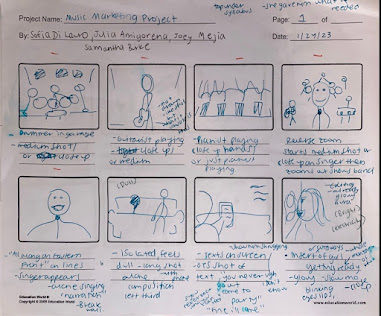


Production: We first shot all the promotional shots on one afternoon in my garage. We used all my instruments, including a drum set, electric guitar, and keyboard to provide the purest realism for this portion of the music video. We used props such as a dark blanket to create a backdrop for one symbolic moment of the video. Set design was also essential to our branding. The band that would be playing is a family band, so creating the atmosphere of a conventional garage family band would complement our branding idea. The next day we filmed the storytelling videos at a fake party, where using costume design was essential to the story.This was to not only give the context of the party but also symbolize each character's persona and how they related to each other. These are a few pictures from the first day of shooting:


    Campaign: After filming, we had all our shots but started to work on our marketing and distribution campaign. When deciding what methods to use, we mainly focused on our target audience and how we could best reach them. Our target audience was mainly girls from 16-21, so primarily young adult women. Using our previous research, we found that using social media was the most effective source of distribution and marketing, especially because our audience was very active on social media. The idea of technological convergence with smartphones was one that we relied on because it meant our specified audience could reach our marketing through various social media platforms. In addition, we wanted to apply a distinctive quality to our band, so we decided to make this a family band. This allowed us to be relatively more unique to other pop bands and gave us more mise-en-scene elements to correlate to our brand, like a uniform costume design for each band member when performing.

    Post Production: After completing the campaign, I was tasked with editing the video. For editing, I used Capcut because it was the platform with which I was most familiar. After transferring all the shots and the song audio to Capcut,  I used the storyboard as a guide to the order of the shots. Although I relied on the storyboard, I also ventured out and tried some of the extra clips we had taken to see if those would look cooler. When editing, I played around with the promotional sequences because I had to try to match the band members' pretend playing to the song's acoustic playing. After putting all the shots in order and matching them to certain beats of the song, I started going through and editing their lighting and composition. For most of the shots I just had to brighten them up or add variations of hues according to what character was on the screen and what they represented. But for the scene of the main girl getting ready in the bathroom, I focused on different editing techniques to create a captivating, surreal montage of a makeover. I utilized different speeds of the shots, as well as overlaying them on top of one another to make her getting ready to appeal to be smooth and effortless. After I had gone through those shots, I went through the whole video and finalized it!
Link to the video:


Presentation: When discussing how we would present, we went over all the information we had written for the campaign and each picked which slides they were most knowledgeable of. For example, if one of my group members was most eloquent when talking about the target audience and its correlation to marketing, they would discuss just that. We ended up splitting up the campaign into four subgroups and each person explaining their part.

Overall, this project taught me a great deal. This project showed me that even if something seems overwhelming at the start, splitting it up into smaller, more doable tasks is going to aid in getting the job done more efficiently and with less stress. Also, managing my time precisely is a quality that I hope to get better at, and this project showed me a way that I could accomplish that in the future. One problem that I did approach when working was the idea of perfectionism. I am the type of person who will procrastinate something because I set a high expectation of what it needs to be, but this project began to help me realize that it doesn't need to be perfect to get the job done. This project helped me see that for my Cambridge portfolio, I should not look so far ahead in what needs to get done but rather focus on the small task ahead of me. 

Friday, January 26, 2024

Planning Process of Music Marketing Project


    The initiation of this Music Marketing Project began with choosing a group of four students where we would then get assigned a specified genre of music. My group was handed the folder of the pop genre, which included four varied pop songs. When choosing what song to select, we needed to take into account the lyricism and visual appeal of the songs. As we listened through all the songs, we weren't completely set on what type of music video we wanted to create, but we knew we definitely wanted some aspect of storytelling. So, focusing on which song gave the biggest opportunity to create a simplistic but representational story that would correlate to the lyrics was huge. We came to the conclusion of picking the song "Electric Feel" by MGMT. 

   Next, we got assigned to complete the marketing and distribution practices research. We had to pick two music production companies and two case studies (artist/band) within the pop genre to research. To split this up among the group, we would all collectively decide on which companies to analyze, and then each person would choose an artist/band to research. In addition to the case studies, we included some brief history of each company and the other artists they have signed with them. To begin the process of choosing the music companies, we started by searching major music production companies and seeing what pop artists were signed to them. The first company we decided on was Columbia Records and the artists we chose were Harry Styles and Rosalia. Meanwhile, the second company was Atlantic Records and we included Ed Sheeran and Charlie Puth. We tried to hand-select artists that came to fame and popularity on their own so we could grasp a better idea of what techniques could be successful. On the other hand, we chose Harry Styles because even though he came from being more well-known due to One Direction, Harry Styles's branding techniques for individualization and interactional marketing were significant enough for us to pick him to research. 

    After completing the research information, we transitioned to the music video. In this part of the project, we faced difficulty in deciding what exact type of music video to create. On a group FaceTime call we discussed what would be easiest to film and also what would be the most engaging and refreshing to see. We decided to do a fusion of a promotional and storytelling video, but the storytelling part would have some artistic influences. We decided to use artistic influences as a form of representation or symbolism for certain ideas in the storytelling portion. Down below is a document created early in our process of planning the type of music video we wanted to create and what could be in each section:


      Some challenges with this portion of the project include finding a set time and day that everyone could meet up to film the music video. Unfortunately one of my group members, Joey, was going to be away on the weekend and we wanted to include him in the promotional scenes. Thankfully we found a replacement and we could still film on the day we had proposed. From here moving forward my group and I must focus on getting all the remaining shots completed and completing the Canva presentation for our band's branding, marketing and distribution plan. 

Friday, December 15, 2023

Representation in the Media

     The representation of how diverse teens, most specifically high schoolers, navigate through overwhelming stereotypes and developing relationships is an utmost notion discussed in Sex Education. This show centralizes on varied groups of individuals and their circumstances. In the beginning of the show, we are presented with the main character's best friend, Eric Effiong, a Black gay adolescent who is depicted as a loud and bold character. The element of costume design is one that assisted the developing of Eric's personality, as well as helping Eric use fashion as a tool of expression and liberation of his sexuality. Mixing of extravagant and clashing colors with many different designs and nuances in the shapes on his clothes allowed for Eric's character to be represented as wild and fun.


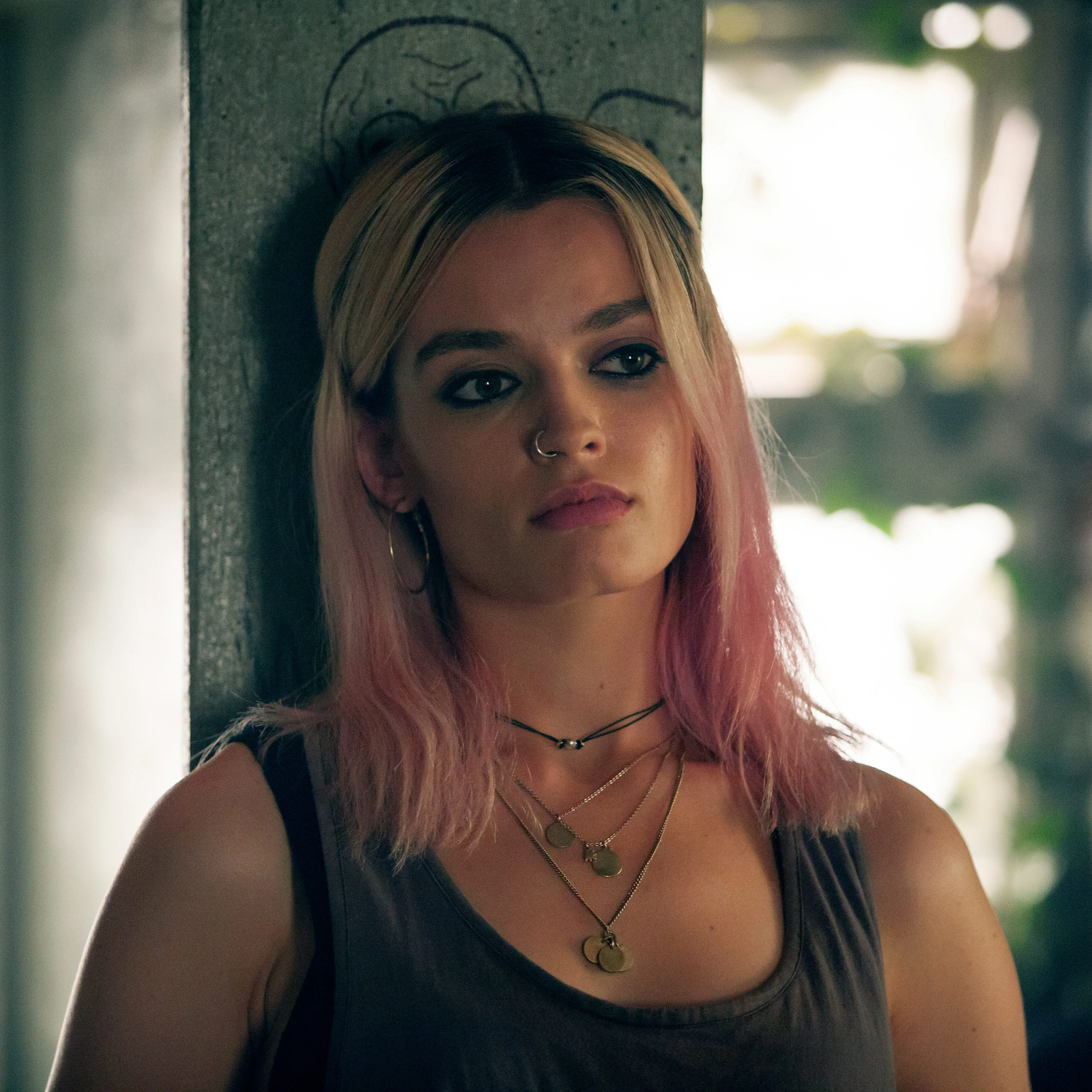
    Another element represented throughout this show is the idea of feminity and not conforming to society. The character that represented this, Maeve Wiley, is a feminist literature lover that isn't afraid to voice her opinion. The tv show uses many mise-en-scene elements to symbolize this character's personality, as well as the big idea she represents. Her wardrobe includes of many dark tones in t-shirts and leather jackets, as well as her having dyed purple and pink hair. Aspects of makeup like dark eyeshadow circling her eyes and dark lips help to appeal to her character. Aspects of costume design mixed with makeup design depict Maeve as a wild, chaotic, and edgy teenager. The idea of Maeve being the "edgy" teenager is depicted in a stereotypical way, but the addition of her being a literature enthusiast brings a new side to a character type represented in many other films.

    
    Not only does Sex Education represent individual characters and their personalities, but this show represents teenagers and the stigmas they struggle around in society. The stigma around sexuality is represented vastly. With Otis's mom, Gillian Anderson, being the sex therapist for many clients, she helps unravel this idea with the interactions and guiding confrontations she has with many teenage clients. Throughout the many insertions of therapy sessions in various episodes, the shot and editing techniques utilized to show these sessions helped with breaking those stigmas. 
    
    The use of close-up and medium shots, along with the eyeline match editing technique, helps establish an intimate tone, regarding the closeness between Gillian and the teenagers. The mix of this intimate tone and the facial expressions captivated by these shots contribute to showing how the teenager feels in sharing their sexual experiences and the atmosphere they must be in to feel comfortable enough to confront their "stigma barriers".


Friday, November 3, 2023

Genre Research- Science Fiction


What is Science Fiction?

The genre of Science Fiction is one that centers on telling a story based on fictional science notions that aren't accurate or confirmed by mainstream science. This film genre has been around since the early years of silent cinema, only getting taken more seriously after Stanley Kubrick's 2001: A Space Odyssey, and then future Science Fiction getting inspired by George Lucas's Star Wars. These film's audiences are more specified, compared to other genres like Drama, due to the content in the film and the focus of the films, usually centralizing on political or philosophical issues.


Conventionalities in Science Fiction

The orthodox content in typical Science Fiction films would include the plot relating to the development of newly built technology (robots, spaceships, etc.) or depending on a scientific notion (time travel). While some Science Fictions depend on these futuristic, scientific developments for the main plot, some also combine aspects of withholding a dystopian/utopian society and expository politics. Throughout the storyline, the setting consists of places like other planets, or our own planet altered. The time takes place either in the fictional future timeline or a historical timeline.

In Science Fiction, the conventions in production techniques consist of using specific props in accordance with the futuristic of scientific developments or the film, for example, a certain prop of a spaceship. For costumes, the utilization of costume acts as a significant indicator of the time period and the advancements that come with that in the film, for example, if the film is a futuristic film about going to outer space, the costumes will showcase that with more developed gear and usage of astronaut suits.

Science Fiction is publicized through the usage of posters and trailers that depict these content conventions. For example, in the thumbnail of certain Science Fiction movies, futuristic aspects including setting, props, and costumes are witnessed, giving context to the audience of what type of film they are to watch. For example, in the film E.T. The Extra-Terrestrial, the thumbnail shows the E.T., the alien, as the main center, along with the setting of the Moon behind him.


Science Fiction Films

The film Hunger Games is a Science Fiction due to its futuristic elements and its quality of being a dystopia. The juxtaposition between the film's hidden dystopia and its glorified utopian Capital reinforces the idea of a corrupt and totalitarian regime. The film reinforces these ideas of society versus the government by depicting these 13 districts living in impoverished states while the Capital seizes to live in a secluded bubble of wealth, control, and unlimited resources. This film succeeds in introducing a philosophical idea about the way our society is governed and restricted, by reflecting certain aspects of our reality but without breaking our imagination. The futuristic elements come in as being visual concepts, especially in the Capital. Technological advancements including computer-controlled illusions, controlled environmental states, and hovercrafts are a few of the inventions that are seen throughout the film. These futuristic elements reestablish the timeline for the movie, which is set in the future.

The film Her is also known as a Science Fiction for its futuristic qualities and undermining message. The recurring theme of technology and the human character's reliance on and innate connection to AI is a different, less noticeable approach of Science Fiction, but is one that connects the audience with the world the characters are living. Instead of being in conflict with something like the government or an alien, Theodore, the main character, is in conflict with himself and his past relationship. This type of Science Fiction is one that delves into humanity and Science Fiction aspects of advanced technology and a futuristic world.

Other Science Fiction films include:

Divergent:


E.T. The Extra-Terrestrial:


Replicas:


Interstellar:

Avatar:


Monday, October 30, 2023

Sound Project

    For this project, we were tasked with creating a story through sound effects and foley sounds. We were paired up with a partner to decide on a storyline to portray, as well as plan out specified sounds that would complete a well-rounded soundscape. This auditory storyline would have to occur in a literal 1-2 minute timeline. We would also have to make four of the sound effects be created by random objects, on a "foley stage."

While my partner and I brainstormed of a storyline to depict, we came to the conclusion of a more simple story and a more intricate focus on the layering and assembling of realistic sounds. We decided to portray the story of a teenage girl coming home from school, getting a snack, going upstairs and falling, and then going to her room and listening to music. To effectively plan our project, we created a chronological outline of all the sounds we would be using: Sound scape outline (2).docx

    When breaking down the project, we first broke down the scenes we would have embedded into our project. We split our project into five scenes: arriving home, downstairs in the house, downstairs in the kitchen, going upstairs and falling, and going upstairs. We thought of the primary sound effects that would make up each scene, as well as the significant minor sound effects that build the realistic soundscape. For example, in the scene of the girl walking to the front door, the primary sound effect would be the footsteps heading to the house, but incorporating the camouflaged sound effects of the girl's clothes rustling and her backpack moving makes the scenario more representative of the real event.

After choosing the sound effects we would utilize, we started to identify which sound effects we wanted to do as foley sounds. We decided to choose the sound effects that would sound the most realistic in accordance with what they were representing. For example, when the girl was getting a packaged snack out of the fridge, I crinkled a plastic wrapper stuffed with a crumbled piece of paper. In addition, we had to be very meticulous when creating the foley sounds for the footsteps, choosing specified floors for different areas of the house the girl would be walking on. Here is a video of some of the foley sound effects we created: https://www.youtube.com/watch?v=YunrEh-5F-s   

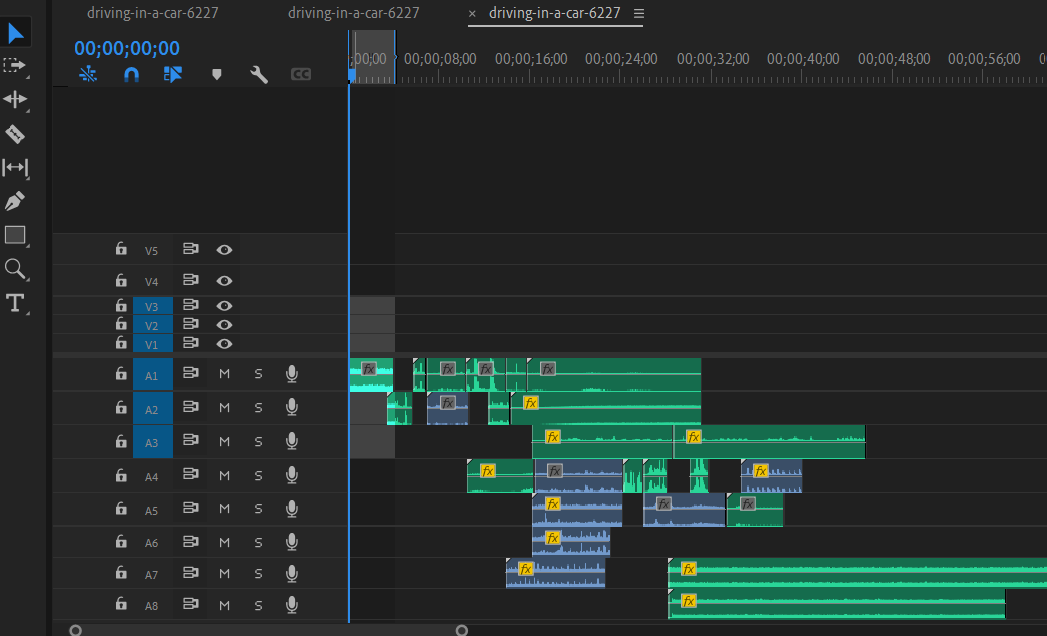
Lastly, we began to edit using Adobe, really honing in on layering the sound effects effectively. Here is a picture of the first scene of the girl arriving home:

Final project:https://youtu.be/FARAVuFajb4?si=jRYA17wdmz5PxU1f 


Final Project!

 Final Project! Hey blog readers. It is time. The project is finally done.  This has been a heck of a journey but it has been an extremely r...